I wanted to create another movement piece to complete my project however, this time I wanted the angle to be from above. I organised within my school a day to set up my space and film the piece using a Drone and a high tech camera also filming from the side. I am really pleased with the result as the shots they got of me creating this piece are incredible and really shows my progression of the charcoal on the paper.

Evaluation
For this art project, we were given the title ‘Structure’.
I chose to call my project ‘Movement within dance’ relating to the structure of
a dancer. From using this title, I followed several different steps in enabling
me to complete my final piece. My final piece was managed to be completed by
having done lots of preparation and planning in my sketchbook and my online
blog. For my final piece, I have created a large-scale charcoal drawing and a
video inspired by the artist Hannah Hansen. I have used 9 A1 pieces of sugar paper
to create one large sheet. I then used charcoal to create the movement and set
the work with a can of hairspray. Using these materials helped give my work
more of a smooth and final look and using music towards the piece also helped
give my work a sense of performance along with myself moving on the paper. I am
happy with how the video and the piece turned out as the paper was not easy to
keep still due to it not being one large canvas. Some of my ideas for this
piece did not work as well due to the paper (performing the choreography)
however, if I were to re-create this piece I would get a large sheet of
material or a roll of paper so the charcoal would be much easier to apply when I
am moving and not having to worry about creases and edges. Furthermore, the
paper would be much more stable. My work would be displayed on a wall or large
board and I would project my two films on top of the work and keep them on a
loop. Here my audience would be able to view how I created the piece and view
the movement that was supposed to happen on the piece. I have taken one A1 part
of my piece and projected the films on top to show a small idea of what the
presentation would look like, which I have linked on my blog and put on DVD. Overall,
I am happy with my final piece as the work shows exactly how I wanted to
portray my movement onto the paper and how a dancer’s movement can create many
different structures when put down onto paper.
Hannah Hansen Final Piece: Presentation
Here I have filmed my one part of my final piece with my videos projected on top. This gives an idea of what my final piece would look like when being presented.
Hannah Hansen Final Piece: Images

This is the set up I used to produce my final piece. I hired out our school theatre to assure I had a big enough space to produce and film. I taped 9 A1 sheets together and then stuck that to the floor to stop the paper from moving. I also set up two cameras from different angles of the room to film my process of creating the work. Having two angles helped show how my body portrayed movement through charcoal onto paper. I also brought in my speakers to listen to the song whilst producing the work.


These images are showing the end result of myself and the piece. I really liked the look of these images as it shows what parts of my body worked/moved most on the paper. I really enjoyed creating this piece as I got to show how I used movement to improvise and produce the pattern onto paper using charcoal and my body.
Hannah Hansen Final Piece: Video
This is the final video for my inspired final piece. I filmed on two cameras from different angles to capture the full effect of the piece as I had only one chance to get it right. I chose to have the video in black and white as it helps focus on the charcoal; the pattern being produced on the paper. Overall, I am very happy with the video as it shows exactly how I produced the piece and how my body moved to create the pattern.
Sam Smith Choreography
This dance is a short movement piece that myself and Arianna choreographed along with my Hannah Hansen final piece. My original ideas were to have us perform the dance onto the paper using charcoal however, due to the paper moving a lot we decided to keep the dance as a separate piece to show what we would have tried to portray on paper. We used the same song 'When Will I Know - Sam Smith' when creating both pieces so both movements matched the song.
Hannah Hansen: Filming Ideas
I came across a video on YouTube and when watching, it gave me an idea of using paint or another media to show how movement between dancers can in a way be transferred onto one another. I really love how they have captured the movement between the two dancers and how they use so many different ways to show the attachment between them. This has inspired me to also create a similar piece of choreography using these ideas and also linking this video with my research on the artist Hannah Hansen. I feel creating the videos and also the inspired Hansen piece will help my project develop by showing how I can physically make art whilst dancing.
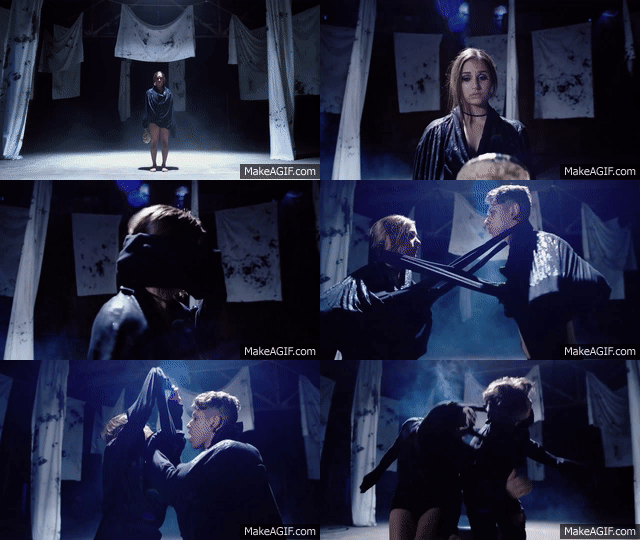

Hannah Hansen: Testing
Here I have created a short video of myself testing different chalks, paper and paper size for my inspired Hannah Hansen final piece. I am very happy with the outcome of all the practice pieces as they have given me an understanding of what works best with what paper. I have decided I will use the black charcoal onto white paper for the final sustained piece as it looks really bold and much neater than the white onto black paper. I also feel that having a larger surface area gives the piece much more freedom therefore, after testing A2 size, I would like to move on to testing this onto an even bigger scale. Furthermore, when creating the A2 piece, I moved to the rhythm of the song 'Halogen Hills - The Atlantic' as it is a nice slow paced song however, has changes in rhythm and tempo which gave me the opportunity to test speed. My next step is to choreograph movement to a song and perform the dance onto paper using charcoal.
Eadweard Muybridge: Zoetrope
Here are the final images and video of my Zoetrope. Overall I am pleased with the outcome as it shows my initial idea of a dancer's movement through a sequence of images. If I were able to re-create this I would use a stronger version of black card to give it a more circular shape.


Shinichi Maruyama: Large scale piece
Here is a picture of my large scale chalk piece. Unfortunately, it did not turn out as well as I thought it would however, I feel it still shows what I was trying to portray. To improve this piece, I would have the dancer wear colourful clothing rather than all black. Therefore, I would have more colours to blend and work with.


Shinichi Maruyama: images
Here are images from a quick photoshoot I did of a dancer doing a sequence of leaps and turns. I have taken all 86 images onto photoshop and layered them on one another. Here is the final outcome.

I will use this image to create a large scale chalk piece inspired by Maruyama.
Shinichi Maruyama
Maruyama was born in Japan in 1968 and moved to New York in 2003. Her
project 'Nude' was about trying to capture the human body's figure in
motion and showing the beauty of both within a photograph. The human form is
transformed into a sculpture by combining 10,000 individual photographs of a
dancer. Putting together these moments creates an image which appears to
be something different to what actually exists when we see it through a
human eye. This creates a connection to a human being's perception of movement
within a dancer and life as a whole.


Starter Footage
Here I have filmed my Grade 6 Ballet Class as a starting point for my ideas of movement. I have put together a few of our barre and centre exercises which show how the body should move within ballet and the technique you have to work on to go further on into an examination/next grade. I will continue to upload my own personal footage onto this blog to give a variety of clips which show my development and ideas within this project.
Quick Photoshoot
5th February 2017
After an 8 hour ballet rehearsal with 3 hours of pointé work I decided to quickly capture my feet in their current state after when I had arrived home. These images are very 'mild' images of how my feet have looked compared to much harder and longer rehearsals, such as longer hours on pointé etc. I feel capturing my own dance process throughout this project will help show the audience how dancers suffer many bruises, blisters and cuts throughout the dance process along with the beautiful side of things; showing the pain from under the beauty.


Powerful Image: Tiejun Wang
I came across this photograph below when doing some research on the internet. This image was taken by press photographer Tiejun Wang. It is titled 'Sweat Makes Champions' which won second prize in the Daily Life, Singles, category at the World Press Photo contest. The image is showing four young girls doing toe-pressure training at their gymnastics school in China. This training went on for 30 minutes to strengthen their muscles in their toes, legs and ankles. Having strong muscles and ankles in dance and gymnastics is a must for dancers due to the amount of pressure that is applied in all styles of dance. From a non-dancer's perspective this would seem very tough and 'wrong' to make these girls do such a thing for so long however, from a dancer's perspective this is a great exercise to for the girls to do as their strength will become stronger and process from a much younger age therefore, helping the girls become much more powerful dancers/gymnasts when they are older. It is very important to look after the feet and care for them throughout training, so exercises such as this are really important. This image has inspired me to look more into how a dancers perspective is much different to someone who looks into the dance world and produce more artwork showing how we change are bodies and why we put ourselves through the pain.

Eadweard Muybridge


Muybridge was an English Photographer, 1830-1904. He looked at pioneering work and creating studies of motion through photography and also did some work on motion-picture projection. Muybridge's pioneering work consisted on animal locomotion in 1877 -78. He used multiple cameras to capture motion in stop-motion photographs. Muybridge also had a device called a 'Zoopraxiscope' which he invented in 1879. This projected motion pictures onto a film strip which was rotated on glass disks rapidly to give the impression of motion. The stop-motion images he had captured were painted onto the glass or produced with holes onto the film strip. This is now used in cinematography. It is said that this was in fact the first ever projector produced. In the 1880's Muybridge then went onto the University Pennsylvania, Philadelphia. Here he produced over 100,000 images of animals and humans in motion. Muybridge managed to capture what the human eye cannot distinguish as separate movements.
I really like the idea of using Muybridge's idea of capturing motion within my project as dance is all about movement and the structure of how dancers get their bodies to move in such ways. Although I do not own a Zoopraxiscope and only one camera I have thought of a different way to produce my own inspired photography. I could set up my camera in my dance studio and record dancers movement as a film. I could then take this footage and pause the clip each second to produce images. On the other hand, I could set my camera onto the continuous shutter, meaning I could capture many images all at once as the dancer moves. All of my footage could then be turned into short films, gifs or presented in the style of Muybridge as a film strip. This is one idea that could help me progress my project.


(Zoopraxiscope)
Subscribe to:
Posts (Atom)